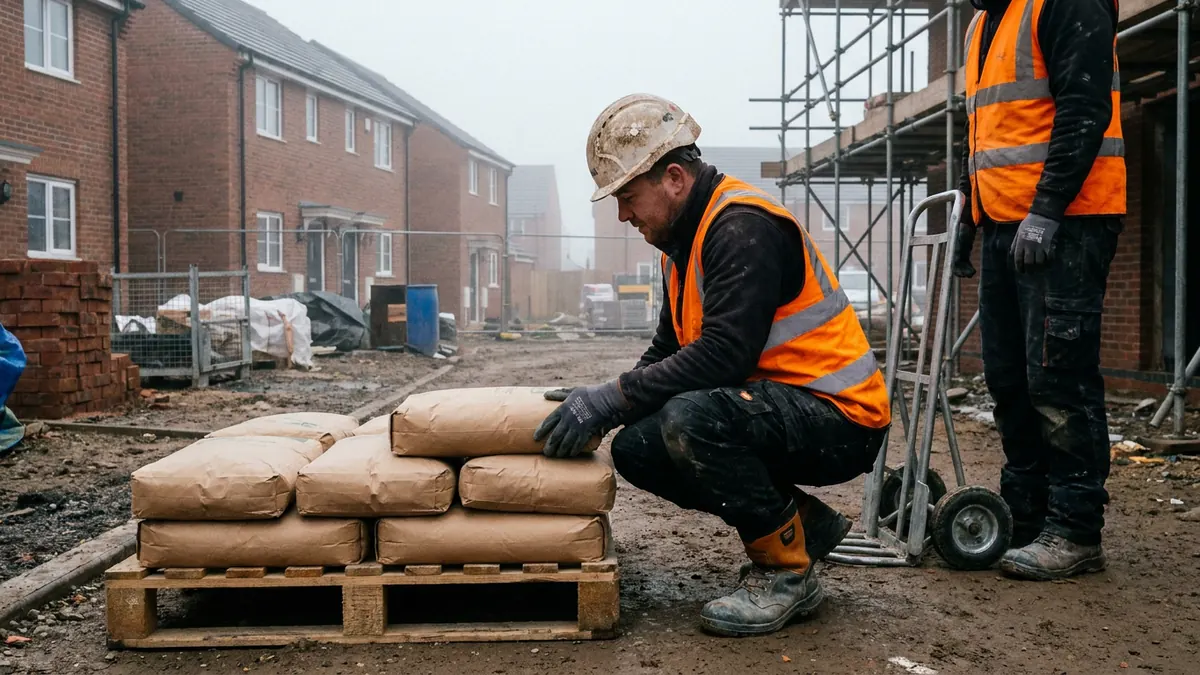
Ask a site supervisor how to judge a lift and you will often hear one word: TILE. It is a quick way to remember the four things that make manual handling risky — the Task, the Individual, the Load and the Environment. This guide explains what a TILE manual handling assessment covers, how it links to the law in Great Britain, how to apply it to real site jobs, and where HSE’s simple filters tell you a more detailed assessment is needed.
What TILE stands for
| Letter | Factor | The question to ask |
|---|---|---|
| T | Task | What movements, postures, distances and how often? |
| I | Individual | Who is doing it, and are they able, trained and fit to do it today? |
| L | Load | How heavy, bulky, unstable, hard to grip, sharp or hot is it? |
| E | Environment | What are the space, floor, levels, weather and lighting like? |
TILE is a memory aid used widely in industry training; it is not a term written into the regulations. What the law sets out is very close to it. Schedule 1 of the Manual Handling Operations Regulations 1992 lists the factors an employer must consider when assessing manual handling: the tasks, the loads, the working environment, individual capability and other factors — for example, whether personal protective equipment or clothing hinders movement or posture. That is why you will sometimes see the acronym written as TILEO.
Source: The Manual Handling Operations Regulations 1992, Schedule 1 — legislation.gov.uk (accessed 10 November 2026).
The law behind a TILE assessment
Regulation 4 of the Manual Handling Operations Regulations 1992 sets out the employer’s duties in order:
- Avoid manual handling that involves a risk of injury, so far as is reasonably practicable.
- Where it cannot be avoided, make a suitable and sufficient assessment, having regard to the factors in Schedule 1 (the TILE factors).
- Reduce the risk of injury to the lowest level reasonably practicable.
- Give workers general indications and, where reasonably practicable, precise information on the weight of each load and its heaviest side if the centre of gravity is off-centre.
The assessment must be reviewed if there is reason to suspect it is no longer valid or if the job changes significantly. Regulation 5 puts a duty on employees too: make full and proper use of any system of work your employer provides to reduce the risk. The legislation.gov.uk text shows these regulations apply in England, Wales and Scotland.
HSE adds a point many people get wrong: the law does not set specific weight limits. Weight matters, but it is only one of the factors.
Sources: regulations 4 and 5 (legislation.gov.uk); HSE, Manual handling at work; HSE, L23 Manual handling: Guidance on Regulations (all accessed 10 November 2026).
TILE on a building site: what each factor looks like
| Factor | Typical site examples | Possible controls |
|---|---|---|
| Task | Lifting blocks from ground level up to a scaffold lift; twisting to throw waste into a skip; carrying materials up stairs; holding a board overhead while it is fixed | Deliver and store at working height; turn the feet, not the trunk; use a hoist or lifting aid; plan rest breaks |
| Individual | A new starter; someone returning after a back injury; a young or temporary worker; a worker who does not have English as their first language | Supervision; adjust the task; check understanding of the method; make sure training has actually been given |
| Load | Bagged materials; large sheet materials that catch the wind; kerbs and lintels that are hard to grip; loads with sharp edges or shifting contents | Smaller packs; handles or lifting aids; gloves suited to the grip; team handling with a plan |
| Environment | Mud and uneven ground; slopes and steps; gusty wind; poor lighting early or late in the day; cramped plant rooms | Clear and firm routes; trolleys suited to the ground; avoid handling sheets in high wind; temporary lighting |
| Other | Bulky gloves, harnesses or wet-weather gear restricting movement | Choose PPE that fits and allows a safe posture |
HSE’s own guidance lists people who may be especially at risk, including inexperienced, new, young or temporary workers, those returning to work after a manual handling injury, and migrant workers who may not have English as their first language. Source: HSE, INDG143 Manual handling at work: A brief guide (accessed 10 November 2026).
Worked example: moving bagged material across site
A delivery of bagged material is left at the site gate. The mixing area is roughly 30 metres away, across a muddy, slightly sloping route. Two operatives are told to carry the bags over by hand. Here is how a TILE assessment changes the plan:
- Task: repeated lifting from pallet height, carrying well beyond 10 metres, likely more than one lift every two minutes.
- Individual: one of the operatives started this week; the other mentions an old back problem.
- Load: check the weight on the bag; bags are floppy and hard to grip at the corners.
- Environment: mud, a slope and a narrow gap by the hoarding.
Against HSE’s simple filters, this job falls outside the low-risk zone (carrying further than about 10 metres without rest, frequent lifts), so it needs a closer look. Following the order the law sets — avoid first — the better options are to have the delivery placed nearer the mixing area, or to move the whole pallet with suitable equipment and a trained operator where the ground allows; if bags must still be moved, use a sack truck on a cleared, firm route and avoid lifting from floor level where possible. The new starter is supervised, and the operative with the back problem is not given the repetitive lifting.
When the simple filters are not enough
HSE’s INDG143 includes simple risk filters to separate low-risk tasks from those that need a more detailed assessment. The filter values are not “safe limits”. According to INDG143, you will need a more detailed assessment (for example using HSE’s MAC tool or the full checklists) for lifting and lowering if:
- the hands have to go outside the zones in the filter diagram, or the weight exceeds the filter values;
- the handling involves torso twisting;
- it is more frequent than one lift every two minutes;
- it is done by a team, or it is complex (weights vary a lot, several start and finish points);
- the load is difficult to grasp or handle;
- the person may be at significant risk (for example new to the job, young, or with a recent injury or health problem).
For carrying, the lifting filter values only apply when the load is held against the body, carried no further than about 10 metres without resting, does not stop normal walking or block the view, and does not need the hands below knuckle height or much above elbow height. For pushing and pulling, a task is likely to be low risk if the force is applied with the hands, the torso is largely upright and not twisted, the hands are between hip and shoulder height, and the distance without a pause is no more than about 20 metres. Slopes, uneven floors, tight spaces or trapping hazards call for a more detailed assessment, for example with HSE’s RAPP tool.
Source: HSE, INDG143 (rev4) — hse.gov.uk/pubns/indg143.htm; HSE, Assess manual handling you can’t avoid (both accessed 10 November 2026).
Your part as a site worker
- Use the system of work. If a sack truck, hoist or team lift is planned, use it — that is your legal duty under regulation 5.
- Speak up. HSE tells employers to consult and involve the workforce in risk assessments; you often know which jobs are awkward and how to fix them.
- Report early. Tell your supervisor about pain, a previous injury or anything that makes a task harder for you today.
- Do not rely on technique alone. INDG143 is clear that training on its own cannot overcome badly designed tasks, unsuitable loads, a poor environment or a lack of mechanical aids.
Quick TILE checklist for a site task
Our own pocket checklist — use it before you lift, and raise any “yes” with your supervisor:
| Check | Yes / No |
|---|---|
| T — Will I need to twist, stoop, reach up or hold the load away from my body? | ☐ / ☐ |
| T — Is it far, frequent, or without proper rest? | ☐ / ☐ |
| I — Is this new to me, or do I have an injury or health issue that affects it? | ☐ / ☐ |
| L — Is the load heavy, bulky, unstable, hard to grip, sharp or hot? Do I know its weight? | ☐ / ☐ |
| E — Is the route uneven, slippery, sloping, cramped, windy or badly lit? | ☐ / ☐ |
| O — Is my PPE or clothing restricting how I move? | ☐ / ☐ |
| Is there an aid (trolley, sack truck, hoist) or a way to avoid the lift? | ☐ / ☐ |
Learn more
Our manual handling awareness course covers this topic in seven short modules: what manual handling is and how it can hurt you; avoiding it first; spotting the risk before you lift (the task, you, the load and the area); lifting and lowering technique; carrying, pushing and pulling; handling aids and team lifts; and looking after your body. It is awareness training and does not replace your employer’s risk assessment or your site induction.
For links to the official bodies — HSE, CITB, CSCS, GOV.UK and others — see our page of official UK training resources.
Frequently asked questions
What does TILE stand for in manual handling?
Task, Individual, Load and Environment. Some trainers add “O” for other factors, such as PPE or clothing that restricts movement, which matches Schedule 1 of the Manual Handling Operations Regulations 1992.
Is there a maximum weight a worker can lift in the UK?
No. HSE says the law does not set specific weight limits. HSE’s filter values help identify low-risk tasks, but they are not safe limits; the whole task, the person, the load and the environment all count.
Who carries out a TILE manual handling assessment?
The employer is responsible for the assessment under regulation 4. In practice a supervisor or competent person often carries it out, and HSE recommends involving the workers who do the job.
Does an online course replace a manual handling risk assessment?
No. Training helps you understand the risks, but it does not replace the employer’s assessment, the controls it identifies, or practical job-specific training.
Written by the Fixiz Academy editorial team with the help of AI tools and checked against the sources cited (accessed 10 November 2026). Illustrative image generated with AI.