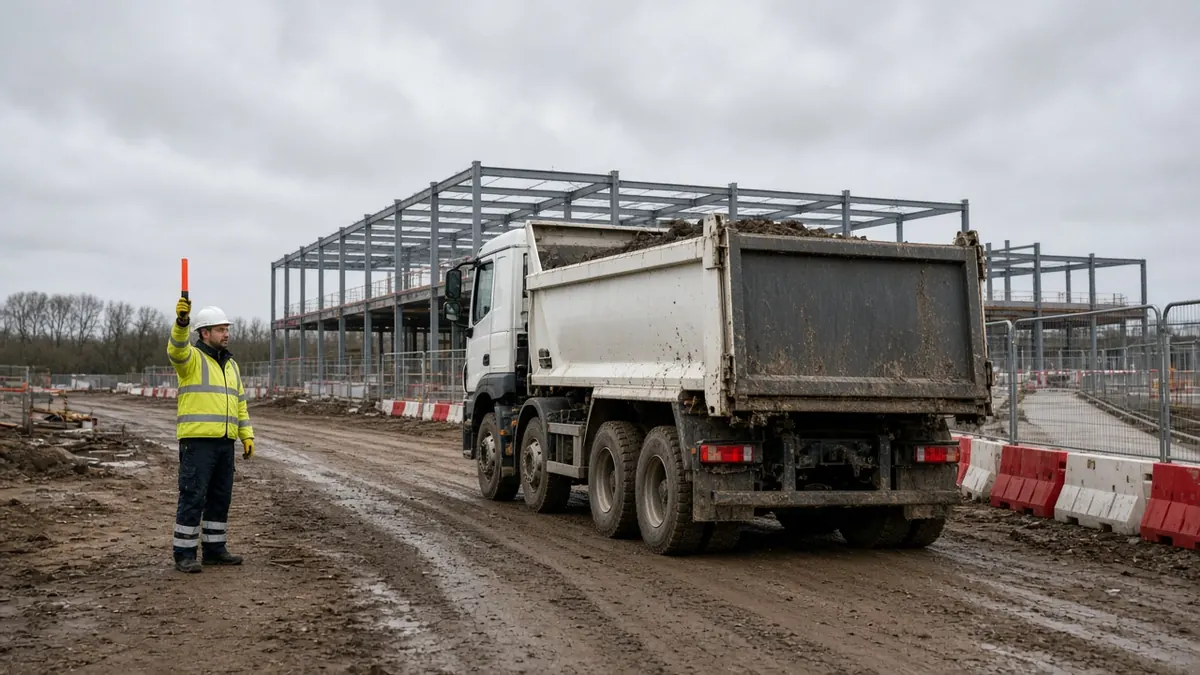
On almost every UK construction site you will hear someone shout for “the banksman” when a lorry needs to reverse. But what does a banksman actually do, when should one be used, and what keeps them safe? This guide explains what a banksman does on a UK site, how the role fits into HSE’s guidance on vehicle safety, the duties before and during a manoeuvre, and how a banksman differs from a crane signaller.
What is a banksman?
HSE defines banksmen as “operatives trained to direct vehicle movement on or around site”, and notes they are often called traffic marshals (HSE – Banksmen and signallers, accessed 11 November 2026).
In practice, a banksman guides drivers of lorries, dumpers, excavators and other site vehicles through manoeuvres where the driver cannot see everything, most often reversing, and keeps people out of the danger zone while the vehicle moves.
A banksman is the last line of defence, not the first
This is the part many people get wrong. HSE is clear that banksmen can still be used for reversing vehicles, but only if trained and authorised, and only where other control measures are not possible. Its guidance places segregation (keeping people and vehicles apart) at the top of the hierarchy.
HSE’s guide Workplace transport safety (HSG136) sets out the logic: removing the need to reverse is the most effective measure, for example with one-way systems, drive-through loading areas and turning areas. If reversing cannot be avoided, it lists measures such as clearly marked reversing areas, keeping non-essential people away, mirrors and other visibility aids, and reversing aids on vehicles such as CCTV and sensors, with a trained banksman used “only when all other options have been exhausted” (HSE HSG136, PDF, accessed 11 November 2026).
The reason is simple: to do the job, a banksman often has to stand relatively close to a reversing vehicle. HSE’s workplace transport pages warn that every year banksmen suffer serious and fatal injuries at work (HSE – Choosing and training safe drivers, accessed 11 November 2026).
What does a banksman do? The main duties
- Agree the plan with the driver before the vehicle moves: where it is going, the route, where it will stop, and which signals you will use.
- Check the area: pedestrians, other vehicles, overhead cables, excavations, edges, soft ground and obstructions.
- Keep people clear of the manoeuvring area and the vehicle’s blind spots.
- Stand in a safe position where the driver can see you at all times, never directly behind a reversing vehicle and never between the vehicle and a fixed object.
- Give clear, agreed signals to guide the vehicle, and stop it if anything changes.
- Stop the manoeuvre if you lose sight of the driver, a person enters the area, or the conditions are no longer safe.
- Report near misses, damaged routes or problems with the traffic plan to the supervisor.
Signals, visibility and the “lost from view” rule
According to HSG136, banksmen should use the standard hand signals used across Europe, and both the banksman and the driver should agree and understand the signals before any manoeuvre starts. The standard signals are given in the Health and Safety (Signs and Signals) Regulations 1996, published by HSE as L64 (HSE – L64, accessed 11 November 2026).
The same guidance says a banksman must be visible to the driver at all times, with precautions such as a high-visibility vest that distinguishes them from other site workers, and equipment such as bats, batons or flags in low light. Radios can help, but the banksman should still be visible. And the rule every driver and banksman should know: if the driver loses sight of the banksman, the driver stops immediately.
Banksman, signaller, traffic marshal: what’s the difference?
| Role | What they do | Typical situation |
|---|---|---|
| Banksman / traffic marshal | Directs vehicle movements on or around site | A tipper lorry reversing to a tipping point |
| Signaller (lifting operations) | Directs crane drivers during lifting operations | Guiding a load being lifted by a crane |
| Pedestrian marshal | Keeps the reversing area free of pedestrians, without directing the vehicle | A delivery in a busy town-centre street |
The definitions of banksman and signaller come from HSE’s banksmen and signallers FAQ; the pedestrian marshal role is described on HSE’s page on choosing and training safe drivers. On some sites the same person may hold more than one role, but each needs the right training and authorisation. To see how these roles fit into the wider site team, read our guide to who’s who on site.
Why reversing matters so much on construction sites
HSE’s guidance on the safe use of vehicles on construction sites (HSG144) states that reversing causes a third of all fatal transport accidents in the construction industry, and that the most effective way to manage the risk is to avoid the need for reversing with one-way systems, turning areas and drive-through loading areas (HSE HSG144, PDF, accessed 11 November 2026). The same guidance says signallers used to direct vehicle and pedestrian movements should be competent, authorised by site management and easy to identify on site.
For the site-wide picture, including keeping pedestrians and vehicles apart, see HSE’s page on traffic management on site (accessed 11 November 2026).
A banksman’s pre-manoeuvre checklist
This is our practical checklist, based on the HSE points above. Always follow your site’s traffic management plan first.
| Check | Ready? |
|---|---|
| Am I trained and authorised by site management for this task? | Yes / No |
| Is reversing actually necessary, or is there a turning area or one-way route? | Yes / No |
| Have the driver and I agreed the route, the stopping point and the signals? | Yes / No |
| Am I wearing high-visibility clothing, with a bat or baton if light is poor? | Yes / No |
| Is my position safe, visible in the driver’s mirror and out of the vehicle’s path? | Yes / No |
| Is the area clear of pedestrians, with a pedestrian marshal or barriers if needed? | Yes / No |
| Does the driver know to stop immediately if they lose sight of me? | Yes / No |
Do you need training to be a banksman?
Yes. HSE says banksmen should only be used if they are trained and authorised, and HSG144 adds that they should be competent and authorised by site management. Ask your employer or the principal contractor how training and authorisation work on your site; online theory alone is not enough.
If you want to learn the theory first, Fixiz Academy’s Banksman: Vehicle Marshalling on Site course (around 50 minutes, in English and Spanish) covers directing vehicles with hand signals, safe positioning and controlling reversing. You can find it in the Fixiz Academy course catalogue. It is awareness training with an unofficial certificate of completion: it does not authorise you to act as a banksman, and it does not replace your employer’s training, authorisation or site induction.
Frequently asked questions
What does a banksman do on a construction site?
A banksman directs vehicle movements on or around site, especially reversing. They agree signals with the driver, keep people clear of the danger area, stand in a safe position where the driver can see them, and stop the manoeuvre if anything changes.
Is a banksman the same as a signaller?
Not quite. HSE uses “banksman” for someone who directs vehicle movement and “signaller” for someone who directs crane drivers during lifting operations. The term “signaller” is also used in some HSE guidance for people directing vehicles.
What happens if the driver cannot see the banksman?
The driver should stop immediately. HSE guidance is clear that the banksman must be visible to the driver at all times.
Does an online course make me a qualified banksman?
No. HSE says banksmen must be trained and authorised. An online course can help you understand the role, but it does not replace practical training, authorisation by site management or your site induction.